Pages

Saturday, April 12, 2014

top old sports car

1961 JAGUAR E-TYPE

File:1963 Jaguar XK-E Roadster.jpg

The Jaguar E-Type (a.k.a. Jaguar XK-E) is a British sports car, which was manufactured by Jaguar Cars Ltd between 1961 and 1975. Its combination of good looks, high performance and competitive pricing established the marque as an icon of 1960s motoring. More than 70,000 E-Types were sold.
In March 2008, the Jaguar E-Type ranked first in a The Daily Telegraph online list of the world's "100 most beautiful cars" of all time.
In 2004, Sports Car International magazine placed the E-Type at number one on their list of Top Sports Cars of the 1960s.
The E-Type was initially designed and shown to the public as a rear-wheel drive grand tourer in two-seater coupé form (FHC or Fixed Head Coupé) and as a two-seater convertible (OTS or Open Two Seater). A "2+2" four-seater version of the coupé, with a lengthened wheelbase, was released several years later.
On its release Enzo Ferrari called it "The most beautiful car ever made".
Later model updates of the E-Type were officially designated "Series 2" and "Series 3", and over time the earlier cars have come to be referred to as "Series 1" and "Series 1½".
Of the "Series 1" cars, Jaguar manufactured some limited-edition variants, inspired by motor racing :
  • The "'Lightweight' E-Type" which was apparently intended as a sort of follow-up to the D-Type. Jaguar planned to produce 18 units but ultimately only a dozen were reportedly built. Of those, two have been converted to Low-Drag form and two others are known to have been wrecked and deemed to be beyond repair, although one has now been rebuilt. These are exceedingly rare and sought-after by collectors.
  • The "Low Drag Coupé" was a one-off technical exercise which was ultimately sold to a Jaguar racing driver. It is presently believed to be part of the private collection of the current Viscount Cowdray.
The New York City Museum of Modern Art recognised the significance of the E-Type's design in 1996 by adding a blue roadster to its permanent design collection, one of only six automobiles to receive the distinction.

Concept versions

E1A (1957)

After the company's success at the Le Mans 24 hr through the 1950s, Jaguar's defunct racing department was given the brief to use D-Type style construction to build a road-going sports car, replacing the XK150.
The first prototype (E1A) featured a monocoque design, Jaguar's fully independent rear suspension and the well proved "XK" engine. The car was used solely for factory testing and was never formally released to the public. The car was eventually scrapped by the factory.

E2A (1960)

Jaguar's second E-Type concept was E2A which, unlike the E1A, was constructed from a steel chassis with an aluminium body. This car was completed as a racing car as it was thought by Jaguar at the time it would provide a better testing ground. E2A used a 3-litre version of the XK engine with a Lucas fuel injection system.
After retiring from the Le Mans 24 hr the car was shipped to America to be used for racing by Jaguar privateer Briggs Cunningham. In 1961, the car returned to Jaguar in England to be used as a test vehicle. Ownership of E2A passed to Roger Woodley (Jaguar's customer competition car manager) who took possession on the basis the car not be used for racing. E2A had been scheduled to be scrapped. Roger's wife Penny Griffiths owned E2A until 2008 when it was offered for sale at Bonham's Quail Auction. It eventually sold for US$4,957,000.

Production versions

Series 1 (1961–1968)

The Series 1 was introduced, initially for export only, in March 1961. The domestic market launch came four months later in July 1961. The cars at this time used the triple SU carburetted 3.8 litre six-cylinder Jaguar XK6 engine from the XK150S. Earlier built cars utilised external bonnet latches which required a tool to open and had a flat floor design. These cars are rare and more valuable. After that, the floors were dished to provide more leg room and the twin hood latches moved to inside the car. The 3.8-litre engine was increased to 4.2 litres in October 1964.
The 4.2-litre engine produced the same power as the 3.8-litre (265 bhp;198 kW) and same top speed (150 mph;240 km/h0), but increased torque from 240 to 283 lb·ft (325 to 384 N·m). Acceleration remained pretty much the same and 0 to 60 mph (0 to 97 km/h) times were around 7.0 seconds for both engines, but maximum power was now reached at 5,400rpm instead of 5,500rpm on the 3.8-litre. That all meant better throttle response for drivers that did not want to shift down gears.All E-Types featured independent coil spring rear suspension with torsion bar front ends, and four wheel disc brakes, in-board at the rear, all were power-assisted. Jaguar was one of the first vehicle manufacturers to equip cars with disc brakes as standard from the XK150 in 1958. The Series 1 can be recognised by glass-covered headlights (up to 1967), small "mouth" opening at the front, signal lights and tail-lights above bumpers and exhaust tips under the number plate in the rear.3.8-litre cars have leather-upholstered bucket seats, an aluminium-trimmed centre instrument panel and console (changed to vinyl and leather in 1963), and a Moss four-speed gearbox that lacks synchromesh for first gear ("Moss box"). 4.2-litre cars have more comfortable seats, improved brakes and electrical systems, and an all-synchromesh four-speed gearbox. 4.2-litre cars also have a badge on the boot proclaiming "Jaguar 4.2 Litre E-Type" (3.8 cars have a simple "Jaguar" badge). Optional extras included chrome spoked wheels and a detachable hard top for the OTS. When leaving the factory the car originally fitted Dunlop 6.40 × 15 inch RS5 tyres on 15 × 5K wire wheels (with the rear fitting 15 × 5K½ wheels supplied with 6.50 X15 Dunlop Racing R5 tyres in mind of competition). Later Series One cars were fitted with 185 - 15 SP41 or 185 VR 15 Pirelli Cinturato as radial ply tyres.
A 2+2 version of the coupé was added in 1966. The 2+2 offered the option of an automatic transmission. The body is 9 in (229 mm) longer and the roof angles are different. The roadster remained a strict two-seater.Less widely known, right at the end of Series 1 production and prior to the transitional "Series 1½" referred to below, a very small number of Series 1 cars were produced with open headlights. Production dates on these machines vary but in right hand drive form production has been verified as late as March 1968. The low number of these cars produced make them amongst the rarest of all production E Types.Following the Series 1 there was a transitional series of cars built in 1967–1968, unofficially called "Series 1½", which are externally similar to Series 1 cars. Due to American pressure the new features were open headlights, different switches, and some de-tuning (using two Zenith-Stromberg carburetters instead of the original three SUs) for US models. Some Series 1½ cars also have twin cooling fans and adjustable seat backs. Series 2 features were gradually introduced into the Series 1, creating the unofficial Series 1½ cars, but always with the Series 1 body style. A United States federal safety law affecting 1968 model year cars sold in the U.S. was the reason for the lack of headlight covers and change in switch design in the "Series 1.5" of 1968. An often overlooked change, one that is often "modified back" to the older style, is the wheel knock-off "nut." U.S. safety law for 1968 models also forbid the winged-spinner knockoff, and any 1968 model year sold in the U.S. should have a hexagonal knockoff nut, to be hammered on and off with the assistance of a special "socket" included with the car from the factory. This hexagonal nut carried on into the later Series 2 and 3.An open 3.8-litre car, actually the first such production car to be completed, was tested by the British magazine The Motor in 1961 and had a top speed of 149.1 mph (240.0 km/h) and could accelerate from 0 to 60 mph (0 to 97 km/h) in 7.1 seconds. A fuel consumption of 21.3 miles per imperial gallon (13.3 L/100 km; 17.7 mpg-US) was recorded. The test car cost £2,097 including taxes.
The cars submitted for road test by the popular motoring journals of the time (1961)such as The Motor, The Autocar and Autosport magazines were specially prepared by the Jaguar works to give better-than-standard performance figures. This work entailed engine balancing and subtle work such as gas-flowing the cylinder heads and may even have involved fitting larger diameter inlet valves.Both of the well-known 1961 road test cars: the E-type Coupe Reg. No. 9600 HP and E-type Convertible Reg.No. 77 RW, were fitted with Dunlop Racing Tyres on test, which had a larger rolling diameter and lower drag co-efficient. This goes some way to explaining the 150 mph (240 km/h) maximum speeds that were obtained under ideal test conditions. The maximum safe rev limit for standard 6-cylinder 3.8-litre E-type engines is 5,500 rpm. The later 4.2-Litre units had a red marking on the rev counter from just 5,000 rpm. The maximum safe engine speed is therefore 127mph (3.31:1 axle) and 137mph (3.07:1 axle) at the 5,500 rpm limit. Both test cars must have reached or exceeded 6,000 rpm in top gear when on road test in 1961.

Series 2 (1968–1971)


Production according to Robson is 13,490 of all types.
 Hallmarks of Series 2 cars are open headlights without glass covers, a wrap-around rear bumper, re-positioned and larger front indicators and tail lights below the bumpers, better cooling aided by an enlarged "mouth" and twin electric fans, and uprated brakes. The engine is easily identified visually by the change from smooth polished cam covers to a more industrial "ribbed" appearance. It was de-tuned in the US with twin Strombergs and larger valve clearances, but in the UK retained triple SUs and the much tighter valve clearances. (Late Series 1½ cars also had ribbed cam covers). The interior and dashboard were also redesigned; rocker switches that met US health and safety regulations were substituted for toggle switches. The dashboard switches also lost their symmetrical layout. New seats were fitted, which purists claim lacked the style of the originals but were certainly more comfortable. Air conditioning and power steering were available as factory options.

Series 3 (1971–1975)[edit]


A new 5.3 L twelve-cylinder Jaguar V12 engine was introduced, with uprated brakes and standard power steering. The short wheelbase FHC body style was discontinued and the V12 was available only as a convertible and 2+2 coupé. The convertible used the longer-wheelbase 2+2 floorplan. The Series 3 is easily identifiable by the large cross-slatted front grille and flared wheel arches, and a badge on the rear that proclaims it to be a V12. Cars for the US market were fitted with large projecting rubber bumper over-riders (in 1973 these were on front, in 1974 both front and rear to meet local 5 mph (8 km/h) impact regulations, but those on European models were considerably smaller. US models also have side indicator repeats on the front wings. There were also a very limited number of six-cylinder Series 3 E-Types built. These were featured in the initial sales literature. When leaving the factory the V12 Open Two Seater and V12 2 ± 2 originally fitted Dunlop E70VR − 15 inch tyres on 15 × 6K wire or solid wheels

top old sports car

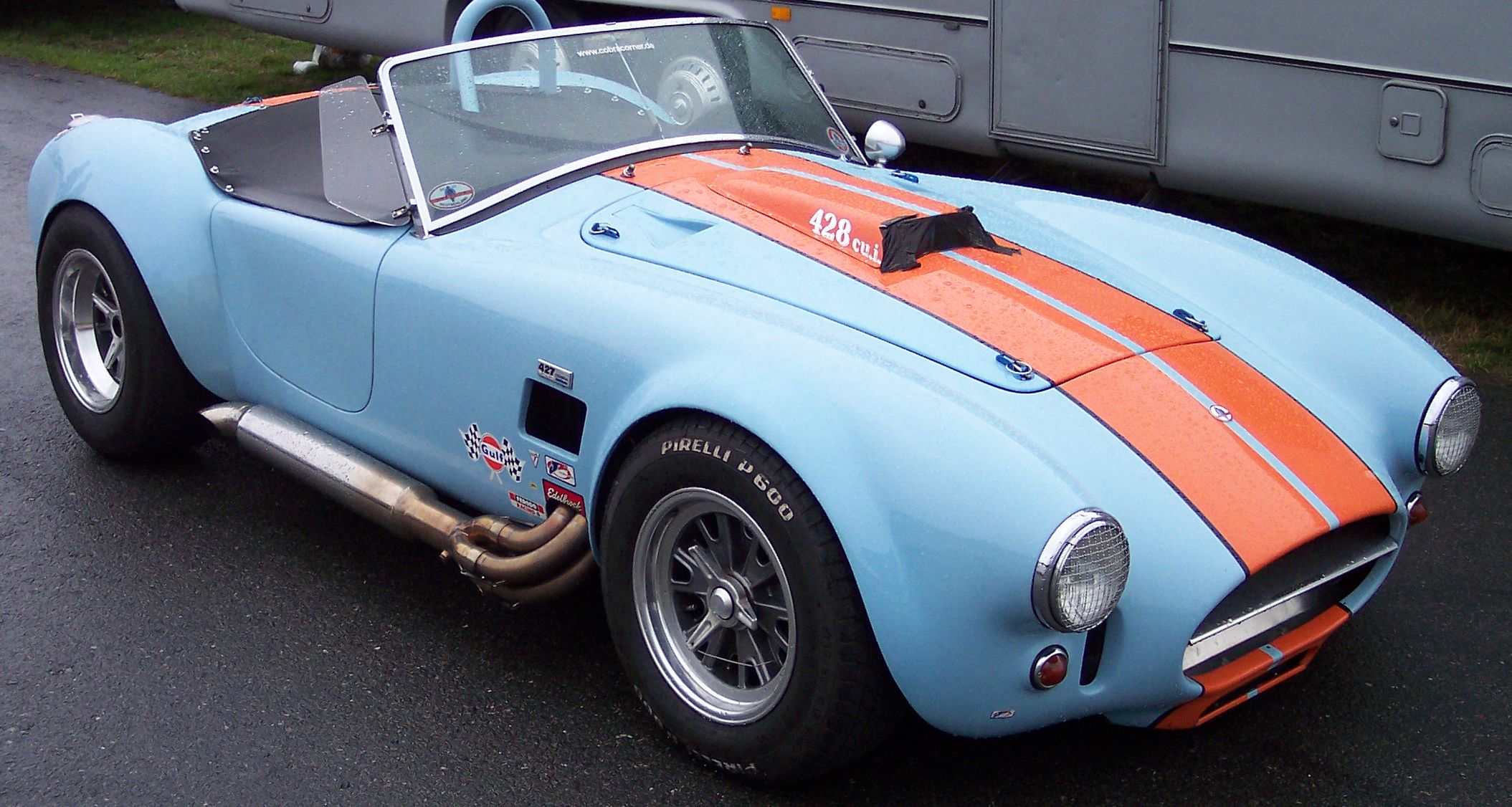
1962 SHELBY 427 COBRA

File:Shelby AC 427 Cobra vl blue.jpg
The AC Cobra, sold as the Ford/Shelby AC Cobra in the United States and often known colloquially as the Shelby Cobra in that country, is an American-engined British sports car produced intermittently since 1962.
Like many British specialist manufacturers, AC Cars had been using the Bristol straight-6 engine in its small-volume production, including its AC Ace two-seater roadster. This had a hand-built body with a steel tube frame, and aluminium body panels that were made using English wheeling machines. The engine was a pre-World War II design of BMW which by the 1960s was considered dated. Bristol decided in 1961 to cease production of its engine and instead to use Chrysler 331 cu in (5.4 L) V8 engines. AC started using the 2.6 litre Ford Zephyr engine in its cars. In September 1961, American automotive designer Carroll Shelby wrote to AC asking if they would build him a car modified to accept a V8 engine. AC agreed, provided a suitable engine could be found. Shelby went to Chevrolet to see if they would provide him with engines, but not wanting to add competition to the Corvette they said no. However,Ford wanted a car that could compete with the Corvette and they happened to have a brand new engine which could be used in this endeavor: Ford's 260 in³ HiPo (4.2 L) engine – a new lightweight, thin-wall cast small-block V8 tuned for high performance. Ford provided Shelby with two engines. In January 1962 mechanics at AC Cars in Thames Ditton, Surrey fitted the prototype chassis CSX2000 with a 260 ci Ford V8 borrowed from Ford in the UK; the 221 ci was never sent. However, early engineering drawings were titled "AC Ace 3.6". After testing and modification, the engine and transmission were removed and the chassis was air-freighted to Shelby in Los Angeles on 2 February 1962. His team fitted it with an engine and transmission in less than eight hours at Dean Moon's shop in Santa Fe Springs, California, and began road-testing.
Production proved to be easy, since AC had already made most of the modifications needed for the small-block V8 when they installed the 2.6 L Ford Zephyr engine, including the extensive rework of the AC Ace's front end bodywork. The most important modification was the fitting of a stronger rear differential to handle the increased engine power. A Salisbury 4HU unit with inboard disk brakes to reduce unsprung weight was chosen instead of the old ENV unit. It was the same unit used on the Jaguar E-Type. On the production version, the inboard brakes were moved outboard to reduce cost. The only modification of the front end of the first Cobra from that of the AC Ace 2.6 was the steering box, which had to be moved outward to clear the wider V8 motor.
The first 75 Cobra Mark I (including the prototype) were fitted with the 260 cu in (4.3 L). The remaining 51 Mark I model were fitted with a larger version of the Windsor Ford engine, the 289 cu in (4.7 L) V8. In late 1962 Alan Turner, AC's chief engineer completed a major design change of the car's front end to accommodate rack and pinion steering while still using transverse leaf spring suspension. The new car entered production in early 1963 and was designated Mark II. The steering rack was borrowed from the MGB while the new steering column came from the VW Beetle. About 528 Mark II Cobras were produced to the summer of 1965 (the last US-bound Mark II was produced in November 1964).
Since late 1962 when the new GM Stingray was shown up briefly by the Mk1 Cobra (until hub failure intervened) the development of the Grand Sport Corvette program had continued at a pace and was thought to be going for a build series of 125 cars. This would allow GM to compete directly in the FIA GT class of racing. Just to compound this Enzo Ferrari was trying to pull another "fast one" on the FIA with the request for the homologation of the 250LM. The FIA had not forgotten the serious lack of production of the 250GTO, which it had granted homologation in advance of Enzo's assured 100 minimum per year. Just thirty-six were produced over three years with two very different chassis, neither of which were too similar to the 250 GT which was supposed to form the basis of the vehicle. In an effort to prepare for the task ahead alternative engines were considered. The 289 cu in (4.7 L) leaf-spring Cobra dominated the US domestic race series (USRRC), with only one race lost in three years. The results in the FIA GT class were different. This was mainly due to the number of circuits that had much higher sustained speeds. Aerodynamics were more important and put the roadster at a disadvantage. As a result, coupe versions were built.
A stroker 289 (325),and the larger 390/427 up to the "cammer" 427 was considered. Shelby was told at the eleventh hour to use the iron 427 cu in (7.0 L). There was little time to fully develop a competition vehicle. The coil spring Cobra production was slow and an insufficient number made to meet FIA's GT homologation. Therefore the S/C (Semi – Competition) was produced by making available to the general production the full race options for the street. By now Enzo was having races recategorised in Italy to prevent the almost inevitable defeat on home soil as the 250LM was not homologated as a GT and would have to run as a prototype. GM had pulled the plug on the Grand Sport and so the five chassis that were built had to run as prototypes and so were placed in a difficult position to say the least.
Shelby had earlier in 1964 fit a larger Ford FE engine of 390 cubic inches (6.4 L) in to CSX2196. Unfortunately the car was not able to receive the development it needed as resources were aimed at taking the crown from Ferrari in the GT class. Ken Miles drove and raced the FE-powered Mark II at Sebring and pronounced the car virtually undriveable, naming it "The Turd". It failed to finish with the engine expiring due to damper failure. A new chassis was required developed and designated Mark III. CSX2196 was revised for the show down at Nassau which allowed a more relaxed class division of racing. This allowed the GT cobras to run with prototype Ford GT, GM Grand Sport Corvettes and Lola Mk.6. The first meeting that the GS Corvettes turned up to in 1963. It was for this event in 1964 that the Fliptop cobra was used. An aluminium 390 cubic inches (6.4 L) engine was used. However, the car failed to finish.
The new car was designed in cooperation with Ford in Detroit. A new chassis was built using 4 in (102 mm) main chassis tubes (up from 3 in (76 mm)) and coil spring suspension all around. The new car also had wide fenders and a larger radiator opening. It was powered by the "side oiler" Ford 427 engine (7.0 L) rated at 425 bhp (317 kW), which provided a top speed of 164 mph (262 km/h) in the standard model and 485 bhp (362 kW) with a top speed of 185 mph (298 km/h) in the competition model. Cobra Mark III production began on 1 January 1965; two prototypes had been sent to the United States in October 1964. Cars were sent to the US as unpainted rolling chassis, and they were finished in Shelby's workshop. Although an impressive automobile, the car was a financial failure and did not sell well. In fact to save cost, most AC Cobra 427s were actually fitted with Ford's 428 cubic inches (7.01 L) engine, a long stroke, smaller bore, lower cost engine, intended for road use rather than racing. It seems that a total of 300 Mark III cars were sent to Shelby in the USA during the years 1965 and 1966, including the competition version. 27 small block narrow fender versions, which were referred to as the AC 289, were sold in Europe. Unfortunately, The MK III missedhomologation for the 1965 racing season and was not raced by the Shelby team. However, it was raced successfully by many privateers and went on to win races all the way into the 1970s. The remaining 31 unsold examples were detuned and fitted with wind screens for street use. Called S/C for semi-competition, an original example can currently sell for 1.5 million USD, making it one of the most valuable Cobra variants.
Shelby wanted the AC Cobras to be "Corvette-Beaters" and at nearly 500 lb (227 kg) less than the Chevrolet Corvette, the lightweight roadster accomplished that goal at Riverside International Raceway on 2 February 1963. Driver Dave MacDonald piloted CSX2026 past a field of Corvettes, Jaguars, Porsches, and Maseratis and recorded the Cobra's historic first-ever victory. Later, Shelby offered a drag package, known as the Dragonsnake, which won several NHRA National events with Bruce Larson or Ed Hedrick at the wheel of CSX2093. Only five Dragonsnake Cobras were produced by the factory, with three others (such as CSX2093) prepared by customers using the drag package.
An AC Cobra Coupe was calculated to have done 186 mph (299 km/h) on the M1 motorway in 1964, driven by Jack Searsand Peter Bolton during shakedown tests prior to that year's Le Mans 24h race. A common misconception is that this incident persuaded the British Government to introduce the 70 mph (110 km/h) maximum speed limit on UK motorways, which up until that year had no speed restrictions, although government officials have cited the increasing accident death rate in the early 1960s as the principal motivation, the exploits of the AC Cars team merely highlighting the issue.
The AC Cobra was a financial failure that led Ford and Carroll Shelby to discontinue importing cars from England in 1967. AC Cars kept producing the coil-spring AC Roadster with narrow fenders, a small block Ford 289 and called the car the AC 289. It was built and sold in Europe until late 1969. AC also produced the AC 428 until 1973. The AC Frua was built on a stretched Cobra 427 MK III coil spring chassis using a very angular steel body designed and built by Pietro Frua. With the demise of the 428 and succeeding 3000ME, AC shut their doors in 1984 and sold the AC name to a Scottish company. The company's tooling, and eventually the right to use the name, were licensed by Autokraft, a Cobra parts reseller and replica car manufacturer owned by Brian A. Angliss.
The Ace chassis numbers read AEX... "A" being the car series and "X" being for export with left-hand drive. Later with the introduction of the Bristol engine the chassis numbers ran "BEX..." When switching to the Ford 2.6 engine the Ace chassis numbers ran "RS..." for Ruddspeed as Ken Rudd may have been influential in the choice of engine. The first Cobra chassis was left hand drive and given the next letter in the alphabet,i.e. C. Then "SX" for "Shelby eXport" ie exported to USA. Therefore the numbers ran CSX... for all the US export Cobras. The four following numbers ran from 2000 sequentially. When the MKIII Cobra was built the identification ran from CSX3000, the 3 signifying coil spring suspension(for left hand drive export). There were other numbers used such as "COB...." for "Cobra Britain" ie RHD home market and and "COX..." for "Cobra Export" ie RHD export other than to USA.

top businessman

Larry Ellison

File:Larry Elllison on stage.jpg
Lawrence Joseph "Larry" Ellison (born August 17, 1944) is an American businessman, best known as the co-founder and chief executive officer of Oracle Corporation, an enterprise software company. In 2014, Forbes listed him as the third-wealthiest man in America and as the fifth-wealthiest person in the world, with a fortune of $48 billion.
Larry Ellison was born in New York City to an unwed Jewish mother. His father was an Italian American US Air Force pilot. After Ellison contracted pneumonia at the age of nine months, his mother gave him to her aunt and uncle for adoption. He did not meet his biological mother again until he was 48.
Ellison graduated from Eugene Field Elementary School in Chicago in January 1958 and attended Sullivan High School at least through the fall of 1959 before moving to Chicago's South Shore, a middle-class Jewish neighborhood. Ellison remembers his adoptive mother as warm and loving, in contrast to his austere, unsupportive, and often distant adoptive father, who adopted the name Ellison to honor his point of entry into the United States, Ellis Island. Louis Ellison was a government employee who had made a small fortune in Chicago real estate, only to lose it during the Great Depression.
Although Ellison was raised in a Reform Jewish home by his adoptive parents, who attended synagogue regularly, he remained a religious skeptic. Ellison states: "While I think I am religious in one sense, the particular dogmas of Judaism are not dogmas I subscribe to. I don't believe that they are real. They're interesting stories. They're interesting mythology, and I certainly respect people who believe these are literally true, but I don't. I see no evidence for this stuff." At age thirteen, Ellison refused to have a bar mitzvah celebration. Ellison says that he has a love affair with Israel that is not connected to religious sentiments, but rather due to the innovative spirit of Israelis, particularly in the technology sector.
Ellison was a bright but inattentive student. He left the University of Illinois at Urbana-Champaign after his second year, after not taking his final exams because his adoptive mother had just died. After spending a summer in northern California, Ellison attended the University of Chicago for one term, where he first encountered computer design. In 1966, aged 22, he moved to northern California.
During the 1970s, after a brief stint at Amdahl Corporation, Ellison began working for Ampex Corporation. His projects included a database for the CIA, which he named "Oracle". Ellison was inspired by a paper written by Edgar F. Codd on relational database systems called "A Relational Model of Data for Large Shared Data Banks". In 1977, he founded Software Development Laboratories (SDL) with two partners and an investment of $2,000; $1,200 of the money was his.
In 1979 the company renamed itself Relational Software Inc., and in 1982 officially became Oracle Systems Corporation after its flagship product, the Oracle database. Ellison had heard about the IBM System R database, also based on Codd's theories, and wanted Oracle to achieve compatibility with it, but IBM made this impossible by refusing to share System R's code. The initial release of Oracle was called Oracle 2; there was no Oracle 1.
In 1990, Oracle laid off 10% of its work force (about 400 people) because it was losing money. This crisis, which almost resulted in Oracle's bankruptcy, came about because of Oracle's "up-front" marketing strategy, in which sales people urged potential customers to buy the largest possible amount of software all at once. The sales people then booked the value of future license sales in the current quarter, thereby increasing their bonuses. This became a problem when the future sales subsequently failed to materialize. Oracle eventually had to restate its earnings twice, and had to settle class-action lawsuits arising from its having overstated its earnings. Ellison would later say that Oracle had made "an incredible business mistake".
Although IBM dominated the mainframe relational database market with its DB2 and SQL/DS database products, it delayed entering the market for a relational database on UNIX and Windows operating-systems. This left the door open for Sybase, Oracle, Informix, and eventually Microsoft to dominate mid-range systems and microcomputers.
Around this time, Oracle fell behind Sybase. From 1990 to 1993, Sybase was the fastest growing database company and the database industry's darling vendor, but soon fell victim to merger mania. Sybase's 1996 merger with Powersoft resulted in a loss of focus on its core database technology. In 1993, Sybase sold the rights to its database software running under the Windows operating system to Microsoft Corporation, which now markets it under the name "SQL Server".
In 1994, Informix overtook Sybase and became Oracle's most important rival. The intense war between Informix CEO Phil White and Ellison was front page Silicon Valley news for three years. In April 1997, Informix announced a major revenue shortfall and earnings restatements. Phil White eventually landed in jail, and IBM absorbed Informix in 2001. Also in 1997, Ellison was made a director of Apple Computer after Steve Jobs returned to the company. Ellison resigned in 2002, saying "my schedule does not currently allow me to attend enough of the formal board meetings to warrant a role as a director".
With the defeat of Informix and of Sybase, Oracle enjoyed years of industry dominance until the rise of Microsoft SQL Server in the late 1990s and IBM's acquisition of Informix Software in 2001 to complement their DB2 database. As of 2013 Oracle's main competition for new database licenses on UNIX, Linux, and Windows operating systems comes from IBM's DB2 and from Microsoft SQL Server, which only runs on Windows. IBM's DB2 still dominates the mainframe database market.
In 2005, Oracle Corporation paid Ellison a $975,000 salary, a $6,500,000 bonus, and other compensation of $955,100. In 2007, Ellison earned a total compensation of $61,180,524, which included a base salary of $1,000,000, a cash bonus of $8,369,000, and options granted of $50,087,100. In 2008, he earned a total compensation of $84,598,700, which included a base salary of $1,000,000, a cash bonus of $10,779,000, no stock grants, and options granted of $71,372,700. In the year ending May 31, 2009 he made $56.8 million. In 2006, Forbes ranked him as the richest Californian.
In April 2009, after a tug-of-war with IBM and Hewlett-Packard, Oracle announced its intent to buy Sun Microsystems.
On July 2, 2009, for the fourth year in a row, Oracle's board awarded Ellison another 7 million stock options. On August 22, 2009, it was reported that Ellison would be paid only $1 for his base salary for the fiscal year of 2010, down from the $1,000,000 he was paid in fiscal 2009.
The European Union approved Oracle's acquisition of Sun Microsystems on January 21, 2010, and agreed that Oracle's acquisition of Sun "has the potential to revitalize important assets and create new and innovative products". The Sun acquisition also gave Oracle control of the popular MySQL open source database, which Sun had acquired in 2008.
On August 9, 2010, Ellison denounced Hewlett-Packard's board for firing CEO Mark Hurd, writing that "the HP board just made the worst personnel decision since the idiots on the Apple board fired Steve Jobs many years ago." (Ellison and Hurd are close personal friends.) Then on September 6, Oracle hired Mark Hurd and made him Co-President alongside Safra A. Catz. Ellison retained the CEO position.
As of March 10, 2010 the Forbes list of billionaires ranked Ellison as the sixth-richest person in the world. Ellison is the third-richest American, with an estimated net worth of US $28 billion. On July 27, 2010, The Wall Street Journal reported that Ellison was the best-paid executive in the last decade, collecting a total compensation of US $1.84 billion. In September 2011, Ellison was listed on the Forbes List of Billionaires as the fifth richest man in the world. Ellison is still the third richest American, with a net worth of about $36.5 billion.
Ellison owns stakes in Salesforce.com, NetSuite, Quark Biotechnology Inc. and Astex Pharmaceuticals. In June 2012, Ellison agreed to buy 98 percent of the Hawaiian island of Lana'i from David Murdock's company, Castle & Cooke. The price was reported to be between $500 million and $600 million.
Ellison agreed to settle a four year-old insider-trading lawsuit by offering to pay $100 million in October 2012. As of September 2012, Ellison was listed on the Forbes List of Billionaires as the third richest American citizen, behind Bill Gates and Warren Buffett, with a net worth of $44 billion. As of October 2012, Ellison was listed just behind David Hamilton Koch as the 8th richest person in the world, according to the Bloomberg Billionaires Index.
In 2013, according to a French magazine, Ellison earned $94.6 million.

top businessman

Amancio Ortega Gaona


Amancio Ortega Gaona (Spanish pronunciation: [aˈmanθio oɾˈteɣa ɡaˈona]; born 28 March 1936) is a Spanish fashion executive and founding chairman of the Inditex fashion group, best known for its chain of Zara clothing and accessories retail shops. In March 2014, he was ranked as the third richest person in the world by Forbes with a net worth of USD $64 billion. The Bloomberg Billionaires Index on March 2014 listed Amancio Ortega Gaona as the world's fourth richest person with reported combined assets of USD $57 billion. He resides with his second wife in an apartment building in GaliciaSpain.
The youngest of four children, Ortega was born in Busdongo de Arbás, León, Spain, and spent his childhood in León. He moved to A Coruña at the age of 14, due to the job of his father, a railway worker. Barely in his teens, Ortega found a job as a shop hand for a local shirtmaker called Gala, which still sits on the same corner in downtown A Coruña. In 1972, he founded Confecciones Goa (his initials in reverse), selling quilted bathrobes which Ortega produced using thousands of local women organised into sewing cooperatives. In 1975, he opened his first Zara store, so called because his preferred name Zorba was already taken. He opened many big Zara Stores during the eighties throughout Galicia. Today, Zara is part of the Inditex group (Industrias de Diseño Textil Sociedad Anónima), of which Ortega owns 59.29%, and aside from over 6,000 stores includes the brands Zara, Massimo Dutti, Oysho, Zara Home, Kiddy's Class, Tempe, Stradivarius, Pull and Bear, Bershka and has more than 92,000 employees.
Ortega keeps a very low profile and, until 1999, no photograph of Ortega had ever been published. He goes to the same coffee shop everyday and eats lunch with his employees in the company's cafeteria. He refuses to wear a tie and typically wears a simple uniform of a blue blazer, white shirt, and gray pants; none of which are Zara products. He is also said to take a very active part in the production and design process in the company.
When he made a public appearance in 2000 as part of the warm-up prior to his company's initial public offering on the stock market in 2001, it made headlines in the Spanish financial press. However, he has only granted interviews to three journalists ever and his secrecy has led to the publication of books, such as Amancio Ortega: de cero a Zara (From Zero to Zara).
In 2011, Ortega announced his imminent retirement from Inditex, parent company of the Zara chain, stating that he would ask Inditex vice-president and CEO Pablo Isla to take his place at the helm of the textile empire.

TOP BUSINESSMAN

Bernard Arnault
File:Bernard Arnault.jpg 
Bernard Jean Étienne Arnault (French: [bɛʁnaːʁ aʁno]; born 5 March 1949) is a French businessman and an art collector. He is the chairman and Chief Executive Officer of LVMH since 1989.
His father Jean Leon Arnault was a manufacturer and the owner of a civil engineering company, Ferret-Savinel. After graduating from the Maxence Van Der Meersch High School in Roubaix, Bernard Arnault was admitted to the École Polytechnique (X1969) from which he graduated with an engineering degree in 1971.
After graduation, in 1971, he joined his father's company. In 1976, he convinced his father to liquidate the construction division of the company for 40 million French francs, and to change the focus of the company to real estate. Using the name Férinel, the new company developed a specialty holiday accommodation. Named director of company building in 1974, he became CEO in 1977. In 1979, he succeeded his father as president of the company.
In 1984, with the help of Antoine Bernheim, a senior partner of Lazard Frères et Cie., Bernard Arnault acquired the Financière Agache, a luxury goods company. He became the CEO of Financière Agache, and therefore took control of Boussac, a textile company in turmoil. Boussac owned Christian Dior, the department store Le Bon Marché, the retail shop Conforama and the diapers industrial Peaudouce. Bernard Arnault sold nearly all the company's assets, keeping only the prestigious Christian Dior brand, and Le Bon Marché department store.
In 1987, shortly after the creation of LVMH, the new luxury group resulting from the merger between two companies, Bernard Arnault exploited a growing conflict between Alain Chevalier, Moët Hennessy's CEO, and Henri Racamier, president of Louis Vuitton. The new group held property rights to Dior perfumes, which Bernard Arnault craved to incorporate into Dior Couture.
In July 1988, Bernard Arnault fronted $1.5 billion to form a holding company with Guinness that held 24% of LVMH’s shares. Following rumors that the Louis Vuitton clan was buying LVMH’s stocks to form a “blocking minority”, Bernard Arnault spent another $600 million to buy another 13,5% of LVMH, making him LVMH’s first shareholder. In January 1989, Bernard Arnault spent another $500 million to control a total of 43,5% of LVMH, and 35% of voting rights, thus reaching the “blocking minority” he needed to stop the dismantlement of the LVMH group. On 13 January 1989, Bernard Arnault was unanimously elected chairman of the executive management board.
Since then, Bernard Arnault led the company through an ambitious development plan, turning it into one of the largest luxury groups in the world, alongside Swiss luxury giant Richemont and French based Kering. In eleven years, LVMH value has been multiplied by fifteen. In the meantime, the sales and profit progressed by 500%. Bernard Arnault promoted the decisions decentralization concerning the brands of the group. The brands are now considered as firms with their own familial history.
Bernard Arnault thinks LVMH has "shared advantages": the strongest brands help financing those that are growing. Bernard Arnault has a portfolio of major brands from the luxury sector for which the stability is secured. This solidity allows new acquisitions and the group development. Thanks to this strategy, Christian Lacroix could open his own fashion house.
In July 1988, Bernard Arnault acquired Céline. In 1993, LVMH acquired Berluti and Kenzo. In the same year, Bernard Arnault bought out the French economic newspaper La Tribune. He could not turn it around, in spite of the 150 million euro of investment. He sold La Tribune in November 2007 in order to buy the other French economic newspaper Les Échos, for 240 million Euros.
In 1994, LVMH acquired the perfume firm Guerlain. In 1996, Bernard Arnault bought out Loewe and it was followed by Marc Jacobs and Sephora in 1997. Were also integrated to the group: Thomas Pink in 1999, Emilio Pucci in 2000 and FendiDKNY and La Samaritaine in 2001.
In the 1990s, Bernard Arnault decided to gather his activities in a unique building in New York in order to symbolize LVMH’s strength and grandeur in the United States. He chose Christian de Portzamparc to realize this project. On 8 December 1999, the LVMH Tower was unveiled in front of Hillary Clinton.
Between 1998 and 2001, Bernard Arnault invested in many web companies: Boo.com, Libertysurf and Zebank through his holding Europatweb. Groupe Arnault also invested in Netflix in 1999.
In 2007, he acquired 10.69% of France's largest supermarket retailer and the world's second largest food distributor, Carrefour through his Blue Capital, which is jointly owned by California property firm Colony Capital.
In 2008, he invested into the yacht business and bought Princess Yachts for 253 million Euros. He then took control of Royal van Lent for an almost identical sum.

Thursday, April 10, 2014

top businessman

Warren Buffett
File:Warren Buffett KU Visit.jpg
Warren Edward Buffett (/ˈbʌfɨt/; born August 30, 1930) is an American business magnate, investor, and philanthropist. He is widely considered the most successful investor of the 20th century. Buffett is the chairman, CEO and largest shareholder of Berkshire Hathaway and consistently ranked among the world's wealthiest people. He was ranked as the world's wealthiest person in 2008 and as the third wealthiest person in 2011. In 2012, American magazine Time named Buffett one of the most influential people in the world.
Buffett is called the "Wizard of Omaha", "Oracle of Omaha", or the "Sage of Omaha" and is noted for his adherence to the value investing philosophy and for his personal frugality despite his immense wealth. Buffett is also a notable philanthropist, having pledged to give away 99 percent of his fortune to philanthropic causes, primarily via the Gates Foundation.
Buffett was born in 1930 in Omaha, Nebraska, the second of three children and only son of U.S. congressman Howard Buffett, a fierce critic of the interventionist New Deal domestic and foreign policy, and his wife Leila (née Stahl). Buffett's DNA report revealed that his paternal ancestors hail from northern Scandinavia, while his maternal ancestors hail from Iberia (present-day Spain) or Estonia. It's been also reported that Warren is not related to Jimmy Buffett despite the same surname. Buffett began his education at Rose Hill Elementary School in Omaha. In 1942, his father was elected to the first of four terms in the United States Congress, and after moving with his family to Washington, D.C., Warren finished elementary school, attended Alice Deal Junior High School, and graduated from Woodrow Wilson High School in 1947, where his senior yearbook picture reads: "likes math; a future stockbroker".
Even as a child, Buffett displayed an interest in making and saving money. He went door to door selling chewing gum, Coca-Cola, or weekly magazines. For a while, he worked in his grandfather's grocery store. While still in high school he was successful in making money by delivering newspapers, selling golfballs and stamps, and detailing cars, among other means. Filing his first income tax return in 1944, Buffett took a $35 deduction for the use of his bicycle and watch on his paper route. In 1945, in his sophomore year of high school, Buffett and a friend spent $25 to purchase a used pinball machine, which they placed in the local barber shop. Within months, they owned several machines in different barber shops.
Buffett's interest in the stock market and investing also dated to his childhood, to the days he spent in the customers' lounge of a regional stock brokerage near the office of his father's own brokerage company. On a trip to New York City at the age of ten, he made a point to visit the New York Stock Exchange. At the age of 11, he bought three shares of Cities Service Preferred for himself, and three for his sister. While in high school he invested in a business owned by his father and bought a farm worked by a tenant farmer.
the Alpha Sigma Phi fraternity. He then transferred to the University of Nebraska–Lincoln where at the age of nineteen, he graduated with a Bachelor of Science in business administration. After being rejected by Harvard Business School Buffett enrolled at Columbia Business School after learning that Benjamin Graham (author of "The Intelligent Investor" – one of his favorite books on investing) and David Dodd, two well-known securities analysts, taught there. He earned a Master of Science in economics from Columbia in 1951. Buffett also attended the New York Institute of Finance. In Buffett's own words:
I'm 15 percent Fisher and 85 percent Benjamin Graham.
The basic ideas of investing are to look at stocks as business, use the market's fluctuations to your advantage, and seek amargin of safety. That's what Ben Graham taught us. A hundred years from now they will still be the cornerstones of investing.
Buffett was employed from 1951 to 1954 at Buffett-Falk & Co., Omaha as an investment salesman; from 1954 to 1956 at Graham-Newman Corp., New York as a securities analyst; from 1956 to 1969 at Buffett Partnership, Ltd., Omaha as a general partner; and from 1970 – present at Berkshire Hathaway Inc, Omaha as its Chairman, CEO.
In 1950, at the age of 20, Buffett had made and saved $9,800 (nearly $94,000 inflation adjusted for the 2012 USD). In April 1952, Buffett discovered Grahamwas on the board of GEICO insurance. Taking a train to Washington, D.C. on a Saturday, he knocked on the door of GEICO's headquarters until a janitor allowed him in. There he met Lorimer Davidson, Geico's Vice President, and the two discussed the insurance business for hours. Davidson would eventually become Buffett's lifelong friend and a lasting influence and later recall that he found Buffett to be an "extraordinary man" after only fifteen minutes. Buffett graduated from Columbia and wanted to work on Wall Street, however, both his father and Ben Graham urged him not to. He offered to work for Graham for free, but Graham refused.
Buffett returned to Omaha and worked as a stockbroker while taking a Dale Carnegie public speaking course. Using what he learned, he felt confident enough to teach an "Investment Principles" night class at the University of Nebraska-Omaha. The average age of his students was more than twice his own. During this time he also purchased a Sinclair Texaco gas station as a side investment. However, this did not turn out to be a successful business venture.
In 1952 Buffett married Susan Thompson at Dundee Presbyterian Church and the next year they had their first child, Susan Alice Buffett. In 1954, Buffett accepted a job at Benjamin Graham's partnership. His starting salary was $12,000 a year (approximately $105,000 inflation adjusted for the 2012 USD). There he worked closely with Walter Schloss. Graham was a tough man to work for. He was adamant that stocks provide a wide margin of safety after weighting the trade-off between their price and their intrinsic value. The argument made sense to Buffett but he questioned whether the criteria were too stringent and caused the company to miss out on big winners that had more qualitative values. That same year the Buffetts had their second child, Howard Graham Buffett. In 1956, Benjamin Graham retired and closed his partnership. At this time Buffett's personal savings were over $174,000 ($1.47 million inflation adjusted to 2012 USD) and he started Buffett Partnership Ltd., an investment partnership in Omaha.
In 1957, Buffett had three partnerships operating the entire year. He purchased a five-bedroom stucco house in Omaha, where he still lives, for $31,500. In 1958 the Buffetts' third child, Peter Andrew Buffett, was born. Buffett operated five partnerships the entire year. In 1959, the company grew to six partnerships operating the entire year and Buffett was introduced to Charlie Munger. By 1960, Buffett had seven partnerships operating: Buffett Associates, Buffett Fund, Dacee, Emdee, Glenoff, Mo-Buff and Underwood. He asked one of his partners, a doctor, to find ten other doctors willing to invest $10,000 each in his partnership. Eventually eleven agreed, and Buffett pooled their money with a mere $100 original investment of his own. In 1961, Buffett revealed that Sanborn Map Company accounted for 35% of the partnership's assets. He explained that in 1958 Sanborn stock sold at only $45 per share when the value of the Sanborn investment portfolio was $65 per share. This meant that buyers valued Sanborn stock at "minus $20" per share and were unwilling to pay more than 70 cents on the dollar for an investment portfolio with a map business thrown in for nothing. This earned him a spot on the board of Sanborn.

top businessman

Mukesh Ambani
File:Mukesh Ambani.jpg
Mukesh Dhirubhai Ambani (born on 19 April 1957) is an Indian business magnate who is the Chairman, Managing Director and largest shareholder of Reliance Industries Limited (RIL), a Fortune Global 500 company and India's second most valuable company by market value. He holds a 44.7% stake in the company. He is the elder son of the late Dhirubhai Ambani and the brother of Anil Ambani. RIL deals mainly in refining, petrochemicals, and in the oil and gas sectors. Reliance Retail Ltd., another subsidiary, is the largest retailer in India.
In 2013, he ranked "37 in the list of "The World's Most Powerful People List - Forbes and in "2010, he was included in Forbes's list of "68 people who matter most". As of 2013, he is India's richest man and second richest man in Asia. Ambani is listed as the 19th richest person in the world with a personal wealth of $19.6 billion. He has retained his position as the India's richest person for the sixth year in a row. Through Reliance, he also owns the Indian Premier League franchise Mumbai Indians. In 2012, Forbes named him as one of the richest sports owners in the world.
He has served on the board of directors of Bank of America Corporation and the international advisory board of the Council on Foreign Relations. He was the Chairman of the Board of Indian Institute of Management Bangalore, one of the leading business schools in India.
Mukesh Ambani was born on April 19, 1957 to Dhirubhai Ambani and Kokilaben Ambani. He has a younger brother, Anil Ambani, and two sisters, Dipti Salgaoncar and Nina Kothari. The Ambani family lived in a modest two bedroom apartment in Bhuleshwar, Mumbai until the 1970s. Dhirubhai later purchased a 14-floor apartment block called 'Sea Wind' in Colaba, where, until recently, Mukesh and Anil lived with their families on different floors.
He attended the Hill Grange High School on a first day at school Peddar Road, Mumbai, along with his brother and where Anand Jain, his close associate, was his classmate. He received BE degree in Chemical Engineering from the University of Mumbai. Mukesh later enrolled for an MBA from Stanford University but dropped out to help his father build Reliance, which at the time was still a small but rapidly growing enterprise.
In 1980, the Indian government under Indira Gandhi opened PFY (polyester filament yarn) manufacturing to the private sector. Dhirubhai Ambani applied for a license to set up a PFY manufacturing plant. In spite of stiff competition from Tatas, Birlas and 43 others, Dhirubhai was awarded the licence. To help him build the PFY plant, Dhirubhai pulled his eldest son Mukesh out of Stanford where he was studying for his MBA. Mukesh Ambani, then dropped out to help his father and initiated Reliance`s backward integration from textiles into polyester fibres and further into petrochemicals, beginning in 1981.
Mukesh Ambani joined Reliance Industries in 1981. He initiated Reliance's backward integration journey from textiles into polyester fibres and further into petrochemicals, petroleum refining and going up-stream into oil and gas exploration and production.
Mukesh Ambani set up Reliance Infocomm Limited (now Reliance Communications Limited), which was focused on information and communications technology initiatives.
Ambani directed and led the creation of the world’s largest grassroots petroleum refinery at Jamnagar, India, which had the capacity to produce 660,000 barrels per day (33 million tonnes per year) in 2010, integrated with petrochemicals, power generation, port and related infrastructure.
In December, 2013 Ambani announced, at the Progressive Punjab Summit in Mohali, the possibility of a "collaborative venture" with Bharti Airtel in setting up digital infrastructure for the 4G network in India. 
In February 2014, an FIR has been filed against Mukesh Ambani for alleged irregularities in the pricing of natural gas from K G Basin. Arvind Kejriwal, who had a short stint as Delhi's chief minister and had ordered the FIR against has accused various political parties of being silent on the gas price issue. Kejriwal has asked both Rahul Gandhi and Narendra Modi to clear their stand on the gas pricing issue.  Kejriwal has alleged that the Centre inflated the price of gas to eight dollars a unit though Mukesh Ambani's company spends only one dollar to produce a unit, which meant a loss of Rs. 54,000 crore to the country annually.

top businessman

Carlos Slim
Carlos Slim Helú.jpg
Carlos Slim Helú (Spanish pronunciation: [ˈkaɾlos esˈlin eˈlu]; born January 28, 1940) is a Mexican business magnate, investor, and philanthropist. From 2010 to 2013, Slim was ranked as the richest person in the world, but that position has been regained by Bill Gates. His extensive holdings in a considerable number of Mexican companies through hisconglomerate, Grupo Carso, SA de CV, have amassed interests in the fields of communications, technology, retailing, and finance. Presently, Slim is the chairman and chief executive of telecommunications companies Telmex and América Móvil.
América Móvil, which was Latin America’s largest mobile-phone carrier in 2010, accounted for around US$49 billion of Slim's wealth by the end of that year. His corporate holdings as of December 2013 have been estimated at US$71.2 billion.
Slim was born in Mexico City, Mexico in 1940 to Maronite Catholic parents, Julián Slim Haddad and Linda Helú, both of Lebanese descent. His father, born Khalil Salim Haddad Aglamaz, emigrated to Mexico from Lebanon (then part of the Ottoman Empire) at the age of 14 in 1902 and changed his name to Julián Slim Haddad. It was not uncommon for Lebanese children to be sent abroad before they reached the age of 15 to avoid being conscripted into the Ottoman army; four of Haddad's older brothers were already living in Mexico at the time of his arrival.
Carlos Slim's mother, Linda Helú Atta, was born in Parral, Chihuahua, of Lebanese parents who had immigrated to Mexico in the late 19th century. Her parents upon immigrating to Mexico had founded one of the first Arabic language magazines for the Lebanese-Mexican community, using a printing press they had brought with them.
In 1911, Julián established a dry goods store, La Estrella del Oriente (The Star of the Orient). By 1921, he had purchased real estate in the flourishing commercial district of Mexico City. These enterprises became the source of considerable wealth.
In August 1926, Julián Slim and Linda Helú married. They had six children: Nour, Alma, Julián, José, Carlos and Linda. Julián senior died in 1953.
Slim and his siblings were taught basic business practices by their father, and at the age of 12, Slim bought shares in a Mexican bank. At the age of 17, he earned 200 pesos a week working for his father's company. He went on to study civil engineering at the National Autonomous University of Mexico, where he also concurrently taught algebra and linear programming. After graduating from college, Slim began his career as a trader in Mexico to hone his business skills. He would then go on to form his own brokerage firm that later expanded to invest in individual businesses, ranging from construction and manufacturing to retail and restaurants. In 1965, he incorporated Inversora Bursátil and bought Jarritos del Sur. In 1966, already worth US$40 million, he founded Inmobiliaria Carso. Three months later, he married Soumaya Domit Gemayel (the Carso name derives from the first three letters of Carlos and the first two of Soumaya), and they remained married until her death in 1999.
Companies found within the construction, real estate, and mining industries were the focus of Slim's early career. By 1972, he had established or acquired a further seven businesses in these categories, including one which rented construction equipment. In 1976, he branched out by buying a 60% interest in a printing business, and in 1980, he consolidated his business interests by forming Grupo Galas as the parent company of a conglomerate that had interests in industry, construction,mining, retail, food, and tobacco.
In 1982, the Mexican economy, which had substantially relied on oil exports, contracted rapidly as the price of oil fell and interest rates rose worldwide. Banks and other businesses were nationalized, crippled, or collapsed, and the peso was devalued. At this time, and during the period of recovery to 1985, Slim invested heavily. He bought all or a large percentage of numerous Mexican businesses, including Reynolds Aluminio, General Popo (General Tire's trading name in Mexico), Bimex hotels, and the Sanborns food retailer. He also acquired a 40% and 50% interest in the Mexican arms of British American Tobacco and The Hershey Company, respectively. He moved into financial services as well, buying Seguros de México and creating from it, along with other purchases such as Fianzas La Guardiana and Casa de Bolsa Inbursa, the Grupo Financiero Inbursa. Many of these acquisitions were financed by the cash flows from Cigatam, a tobacco business which he bought early in the economic downturn.
Slim added the Nacrobre group of companies – which trade in copper and aluminium products – in 1988, along with a chemicals business, Química Fluor, and others.
In 1990, the Grupo Carso was floated as a public company, with share placements initially in Mexico and then worldwide.
Later in 1990, Slim acted in concert with France Télécom and Southwestern Bell Corporation in order to buy the landline telephony company Telmex from the Mexican government. By 2006, 90 percent of the telephone lines in Mexico were operated by Telmex, while his mobile telephony company, Telcel, which was created out of the Radiomóvil Dipsa company, operated almost 80 percent of all the country's cellphones.
In 1991, he acquired Hoteles Calinda (now OSTAR Grupo Hotelero), and in 1993, he increased his stakes in General Tire and Grupo Aluminio to the point where he had a majority interest.
In 1996, Grupo Carso was split into three companies: Carso Global Telecom, Grupo Carso, and Invercorporación. In the following year, Slim bought the Mexican arm of Sears Roebuck.
1999 saw Slim expanding his business interests beyond Latin America; he set up Telmex USA and also acquired a stake in Tracfone, a US cellular telephone company. At the same time, he established Carso Infraestructura y Construcción, S. A. (CICSA) as a construction and engineering company within Grupo Carso. It was also at this time that Slim had heart surgery and subsequently passed on much of the day-to-day involvement in the businesses to his children and their spouses.
América Telecom, the holding company for América Móvil, was incorporated in 2000. It took stakes in various cellular telephone companies outside of Mexico, including the Brazilian ATL and Telecom Americas concerns, Techtel in Argentina, and others in Guatemala and Ecuador. In subsequent years, there was further investment in this sphere, including deals involving companies in Colombia, Nicaragua, Peru, Chile, Honduras, and El Salvador. 2000 also saw a venture with Microsoft which led to the start of the Spanish T1msn portal, later renamed ProdigyMSN.
In 2005, Slim invested in the Volaris airline and formed Impulsora del Desarrollo y el Empleo en America Latina SAB de CV (using the acronym "IDEAL"—roughly translated as "Promoter of Development and Employment in Latin America"), a Mexico-based company primarily engaged in not-for-profit infrastructure development.
Having amassed a 50.1% stake in the Cigatam tobacco company, Slim reduced his holdings by selling a large portion to Philip Morris in 2007 for $1.1bn, while in the same year also selling his entire interest in a tile company, Porcelanite, for $800m. He also licensed the Saks name and opened Saks Fifth Avenue in Santa Fe, Mexico. The following year saw him take a 6.4% stake in The New York Times Company, which increased to 8% by 2012.
On December 8, 2007, Grupo Carso announced that the remaining 103 CompUSA stores would be either liquidated or sold, bringing an end to the struggling company, although the IT tech part of CompUSA continued under the name Telvista with U.S. locations in Dallas, Texas (U.S. Corporate Office) and Danville, Virginia. Telvista has five centers in Mexico (three in Tijuana, one center in Mexicali, and one in México City). After 28 years, Slim became the Honorary Lifetime Chairman of the business. He is also Chairman of Teléfonos de Mexico, América Móvil, and Grupo Financiero Inbursa.
He is building Plaza Carso in Mexico City where most of his ventures will share a common headquarters address.
In March 2012, Slim along with American television host Larry King established Ora TV, an on-demand digital television network that produces and distributes television shows including Larry King NowPoliticking with Larry KingRecessionista, and Jesse Ventura Uncensored. The network was used as an outlet to produce a new show for Larry King after leaving CNN.

top businessman

Bil Gates
File:Dts news bill gates wikipedia.JPG
William Henry "Bill" Gates III (born October 28, 1955) is an American business magnate, philanthropist, investor,computer programmer, and inventor. Gates is the former chief executive and chairman of Microsoft, the world’s largest personal-computer software company, which he co-founded with Paul Allen.
He is consistently ranked in the Forbes list of the world's wealthiest people and was the wealthiest overall from 1995 to 2009—excluding 2008, when he was ranked third; in 2011 he was the wealthiest American and the world's second wealthiest person. According to the Bloomberg Billionaires List, Gates became the world's richest person again in 2013, a position that he last held on the list in 2007. As of March 2014, he is the richest.
During his career at Microsoft, Gates held the positions of CEO and chief software architect, and remains the largest individual shareholder, with 6.4 percent of the common stock. He has also authored and co-authored several books.
Gates is one of the best-known entrepreneurs of the personal computer revolution. Gates has been criticized for his business tactics, which have been considered anti-competitive, an opinion which has in some cases been upheld by judicial courts. In the later stages of his career, Gates has pursued a number of philanthropic endeavors, donating large amounts of money to various charitable organizations and scientific research programs through the Bill & Melinda Gates Foundation, established in 2000.
Gates stepped down as chief executive officer of Microsoft in January 2000. He remained as chairman and created the position of chief software architect for himself. In June 2006, Gates announced that he would be transitioning from full-time work at Microsoft to part-time work, and full-time work at the Bill & Melinda Gates Foundation. He gradually transferred his duties to Ray Ozzie, chief software architect, and Craig Mundie, chief research and strategy officer. Gates's last full-time day at Microsoft was June 27, 2008. He stepped down as chairman of Microsoft in February 2014, taking on a new post as technology advisor to support newly appointed CEO Satya Nadella.
Gates was born in Seattle, Washington, to William H. Gates, Sr. and Mary Maxwell Gates. His ancestry includes English, German, and Scots-Irish. His father was a prominent lawyer, and his mother served on the board of directors for First Interstate BancSystem and the United Way. Gates's maternal grandfather was JW Maxwell, a national bank president. Gates has one elder sister, Kristi (Kristianne), and one younger sister, Libby. He was the fourth of his name in his family, but was known as William Gates III or "Trey" because his father had the "II" suffix. Early on in his life, Gates's parents had a law career in mind for him. When Gates was young, his family regularly attended a Congregational church. The family encouraged competition; one visitor reported that "it didn't matter whether it was hearts or pickleball or swimming to the dock ... there was always a reward for winning and there was always a penalty for losing".
At 13 he enrolled in the Lakeside School, an exclusive preparatory school. When he was in the eighth grade, the Mothers Club at the school used proceeds from Lakeside School's rummage sale to buy a Teletype Model 33 ASR terminal and a block of computer time on a General Electric (GE) computer for the school's students. Gates took an interest in programming the GE system in BASIC, and was excused from math classes to pursue his interest. He wrote his first computer program on this machine: an implementation of tic-tac-toe that allowed users to play games against the computer. Gates was fascinated by the machine and how it would always execute software code perfectly. When he reflected back on that moment, he said, "There was just something neat about the machine." After the Mothers Club donation was exhausted, he and other students sought time on systems including DEC PDP minicomputers. One of these systems was a PDP-10 belonging to Computer Center Corporation (CCC), which banned four Lakeside students—Gates, Paul Allen, Ric Weiland, and Kent Evans—for the summer after it caught them exploiting bugs in the operating system to obtain free computer time.
At the end of the ban, the four students offered to find bugs in CCC's software in exchange for computer time. Rather than use the system via Teletype, Gates went to CCC's offices and studied source code for various programs that ran on the system, including programs in Fortran, Lisp, and machine language. The arrangement with CCC continued until 1970, when the company went out of business. The following year, Information Sciences, Inc. hired the four Lakeside students to write a payroll program in Cobol, providing them computer time and royalties. After his administrators became aware of his programming abilities, Gates wrote the school's computer program to schedule students in classes. He modified the code so that he was placed in classes with "a disproportionate number of interesting girls." He later stated that "it was hard to tear myself away from a machine at which I could so unambiguously demonstrate success." At age 17, Gates formed a venture with Allen, called Traf-O-Data, to make traffic counters based on the Intel 8008 processor. In early 1973, Bill Gates served as a congressional page in the US House of Representatives.
Gates graduated from Lakeside School in 1973. He scored 1590 out of 1600 on the SAT and enrolled at Harvard College in the autumn of 1973. While at Harvard, he met Steve Ballmer, who would later succeed Gates as CEO of Microsoft.In his sophomore year, Gates devised an algorithm for pancake sorting as a solution to one of a series of unsolved problems presented in a combinatorics class by Harry Lewis, one of his professors. Gates's solution held the record as the fastest version for over thirty years; its successor is faster by only one percent. His solution was later formalized in a published paper in collaboration with Harvard computer scientist Christos Papadimitriou.
Gates did not have a definite study plan while a student at Harvard and spent a lot of time using the school's computers. Gates remained in contact with Paul Allen, and he joined him at Honeywell during the summer of 1974. The following year saw the release of the MITS Altair 8800 based on the Intel 8080 CPU, and Gates and Allen saw this as the opportunity to start their own computer software company. Gates dropped out of Harvard at this time. He had talked this decision over with his parents, who were supportive of him after seeing how much Gates wanted to start a company