Pages

Monday, April 14, 2014

top old sports car

1957 MERCEDES 300SL GULLWING


The Mercedes-Benz 300SL was the first iteration of the SL-Class grand tourer convertibles and fastest production car of its day. Internally numbered W198, it was introduced in 1954 as a two-seat sports car with distinctive gull-wing doors and later offered as an open roadster.
Built by Daimler-Benz AG, the fuel-injected production model was based on the company's highly successful yet somewhat less powerful carbureted 1952 race car, the Mercedes-Benz 300SL (W194).
The idea of a toned-down W194 tailored to affluent performance enthusiasts in the booming post-war American market was suggested by Max Hoffman. As such, it was introduced at the 1954 New York Auto Show rather than the Frankfurt or Geneva shows at which other Mercedes models made their debuts. The "300" in its name referred to its three litre engine displacement, and "SL" stood for "Sport Leicht" (Sport Light).
The 300SL was best known for its distinctive gull wing doors, first-ever consumer fuel-injection, and world's fastest top speed. The gull wing version was available from March 1955 to 1957, the roadster from 1957 to 1963. It was followed in the Mercedes line by the 230SL.
New York Mercedes distributor Max Hoffman, Daimler-Benz's official importer in the USA, suggested to Daimler-Benz AG management in Stuttgart that a street version of the 300SL would be a commercial success, especially in America.
The racing W194 300SL was built around a tubular chassis to offset its relatively underpowered carbureted engine. Designed by Daimler-Benz's chief developing engineer,Rudolf Uhlenhaut, the metal skeleton saved weight while still providing a high level of strength. Its unique architecture gave birth to the model's distinctive gull-wing doors, as part of the chassis passed through what would be the lower half of a standard door. Even with the upward opening doors, the 300SL had an unusually high sill, making entry and exit from the car's cockpit problematic. A steering wheel with a tilt-away column was added to improve driver access.
The 300SL's body was mainly steel, except for the aluminum hood, doors and trunk lid. It could also be ordered with an all-aluminium outer skin at tremendous added cost, saving 80 kg (176 lb).
More than 80% of the vehicle's total production of approximately 1400 units were sold in the US, making the Gullwing the first Mercedes-Benz which sold in considerable numbers outside its home market and confirming the validity of Hoffman's suggestion. The 300SL is credited for changing the company's image in America from a manufacturer of solid, but staid, automobiles to that of a producer of sporty cars.
The 300SL's engine, canted at a forty-five-degree angle to the left to allow for a lower hoodline, was the same 3.0 litre straight-6 as the regular four-door 300 tourer. Fitted with a Bosch mechanical Gasoline direct injection system it had almost double the power of the original 86 kW (115 hp) carbureted version.
While not the first fuel-injected car - Mercedes engineers who had developed the principle for the DB 601 fighter aircraft engine had used fuel injection in the tiny 2-stroke Gutbrod they had designed after the War - it was the first to inject fuel directly into the cylinders. This innovation allowed a top speed of up to 260 km/h (161 mph) depending on gear ratio and drag, making the 300SL the fastest production car of its time.
The engine's maintenance requirements were high. Unlike the current electrically powered fuel injection systems, the mechanical fuel pump would continue to inject gasoline into the engine during the interval between shutting off the ignition and the engine's coming to a stop; this gasoline was of course not burned, and washed the oil from the cylinder walls and ended up diluting the engine's lubricating oil, particularly if the engine was not driven hard enough nor long enough to reach a temperature high enough to evaporate it out of the oil.
Exacerbating the problem were the large oil cooler as well as the large volume of oil (10 liters), both oriented more to racing than to street driving, which virtually guaranteed that the oil would not reach a high enough temperature. In practice, many street drivers would block off airflow through the oil cooler, and the recommended oil change interval was 1,000 miles (1,600 km). Operation of the clutch was initially very heavy, later roadsters having an improved clutch arm helper spring which reduced the pedal force. From March 1963 to the end of production, a light alloy crankcase was used on a total of 209 vehicles.
Aerodynamics played an important role in the car's speed, Mercedes-Benz engineers even placing horizontal "eyebrows" over the wheel openings to reduce drag. Unlike many cars of the 1950s, the steering was relatively precise and the four-wheel independent suspension allowed for a reasonably comfortable ride and markedly better overall handling. However, the rear swing axle, jointed only at the differential, not at the wheels themselves, could be treacherous at high speeds or on imperfect roads due to extreme changes in camber. The enormous fuel tank capacity caused a considerable difference in handling depending on the quantity of fuel on board.
In 1952, the original 300SL (model Mercedes-Benz W194) scored overall wins at the 24 Hours of Le Mans, in Bern-Bremgarten, in the sportscar race of the Eifelrennen at the Nürburgring, and in Mexico's Carrera Panamericana. It also managed second and fourth places at its first outing, the Mille Miglia in 1952.
These successes, especially those on the high speed open road races, were rather surprising as the engine then was fitted only with carburetors, producing 175 hp (130 kW), which was not only less than the competing cars by Ferrari and Jaguar, but also less than the road car of 1954. Low weight and low aerodynamic drag made the 300SL fast enough to be competitive in endurance races.

top old sports car

1964 ASTON MARTIN DB5

The Aston Martin DB-5 is a luxury grand tourer that was made by Aston Martin and designed by the Italian coachbuilder Carrozzeria Touring Superleggera. Released in 1963, it was an evolution of the final series of DB4. The DB series was named honouring David Brown (the head of Aston Martin from 1947–1972). The DB5 is famous for being the first and most recognised cinematic James Bond car, first appearing in Goldfinger (1964).
The principal differences between the DB4 Series V and the DB5 are: The all-aluminium engine was enlarged from 3.7 L to 4.0 L, A new robust ZF five-speed transmission (except for some of the very first DB5s) and three SU carburettors Producing 282 bhp (210 kW), which propelled the car to 145 mph (233 km/h), this engine, available on the Vantage (high powered) version of the DB4 since March 1962, became the standard Aston Martin power unit with the launch in September 1963 of the DB5.
Standard equipment on the DB5 included reclining seats, wool pile carpets, electric windows, twin fuel tanks, chrome wire wheels, oil cooler, magnesium-alloy body built to superleggera patent technique, full leather trim in the cabin and even a fire extinguisher. All models have two doors and are of a 2+2 configuration. A three-speed Borg-Warner DG automatic transmission was available as well. At the beginning, the original four-speed manual (with optional overdrive) was standard fitment, but it was soon dropped in favour of the ZF five-speed. The automatic option was then changed to the Borg-Warner Model 8 shortly before the DB6 replaced the DB5.

DB5 Vantage

The high-performance DB5 Vantage was introduced in 1964 featuring three Weber twin-choke 45DCOE side-draft carburettors and revised camshaft profiles, delivering greater top-end performance at the expense of overall flexibility, especially as legendary Webers are renowned as 'full-throttle' devices. This engine produced 315 hp (235 kW). Only 65 DB5 Vantage coupés were built.

DB5 convertible

Just 123 convertible DB5s were produced (also with bodies by Touring), though they did not use the typical "Volante" name until 1965. The convertible model was offered from 1963 through to 1965. Originally only 19 of the 123 DB5 Convertibles made were left-hand drive. 12 cars were originally fitted with a factory Vantage engine, and at least one further convertible was subsequently factory fitted with a DB6 specification Vantage engine.
From October 1965 to October 1966, Aston Martin used the last 37 of the Aston Martin DB5 chassis' to make another convertible model. These 37 cars were known as "Short Chassis" Volantes and were the first Aston Martins to hold the "Volante" name. Although calling it a "Short Chassis" is a bit of a misnomer as the "short" comes from comparing it to the subsequent DB6, which has a longer chassis. When compared to the DB5, it is not "short" but rather the same size, however these cars differ to the DB5 convertible models as they feature DB6 split front and rear bumpers and rear TR4 lights, as also used on the DB6.

DB5 shooting brake

A prototype DB5 shooting brake was custom produced by the factory for David Brown, an avid hunter and dog owner, and 11-12 more coupés were custom modified for Aston Martin by independent coachbuilderHarold Radford. The taillights used were Triumph units, and were also adopted for the succeeding DB6.

Saturday, April 12, 2014

top old sports car

1961 JAGUAR E-TYPE

File:1963 Jaguar XK-E Roadster.jpg

The Jaguar E-Type (a.k.a. Jaguar XK-E) is a British sports car, which was manufactured by Jaguar Cars Ltd between 1961 and 1975. Its combination of good looks, high performance and competitive pricing established the marque as an icon of 1960s motoring. More than 70,000 E-Types were sold.
In March 2008, the Jaguar E-Type ranked first in a The Daily Telegraph online list of the world's "100 most beautiful cars" of all time.
In 2004, Sports Car International magazine placed the E-Type at number one on their list of Top Sports Cars of the 1960s.
The E-Type was initially designed and shown to the public as a rear-wheel drive grand tourer in two-seater coupé form (FHC or Fixed Head Coupé) and as a two-seater convertible (OTS or Open Two Seater). A "2+2" four-seater version of the coupé, with a lengthened wheelbase, was released several years later.
On its release Enzo Ferrari called it "The most beautiful car ever made".
Later model updates of the E-Type were officially designated "Series 2" and "Series 3", and over time the earlier cars have come to be referred to as "Series 1" and "Series 1½".
Of the "Series 1" cars, Jaguar manufactured some limited-edition variants, inspired by motor racing :
  • The "'Lightweight' E-Type" which was apparently intended as a sort of follow-up to the D-Type. Jaguar planned to produce 18 units but ultimately only a dozen were reportedly built. Of those, two have been converted to Low-Drag form and two others are known to have been wrecked and deemed to be beyond repair, although one has now been rebuilt. These are exceedingly rare and sought-after by collectors.
  • The "Low Drag Coupé" was a one-off technical exercise which was ultimately sold to a Jaguar racing driver. It is presently believed to be part of the private collection of the current Viscount Cowdray.
The New York City Museum of Modern Art recognised the significance of the E-Type's design in 1996 by adding a blue roadster to its permanent design collection, one of only six automobiles to receive the distinction.

Concept versions

E1A (1957)

After the company's success at the Le Mans 24 hr through the 1950s, Jaguar's defunct racing department was given the brief to use D-Type style construction to build a road-going sports car, replacing the XK150.
The first prototype (E1A) featured a monocoque design, Jaguar's fully independent rear suspension and the well proved "XK" engine. The car was used solely for factory testing and was never formally released to the public. The car was eventually scrapped by the factory.

E2A (1960)

Jaguar's second E-Type concept was E2A which, unlike the E1A, was constructed from a steel chassis with an aluminium body. This car was completed as a racing car as it was thought by Jaguar at the time it would provide a better testing ground. E2A used a 3-litre version of the XK engine with a Lucas fuel injection system.
After retiring from the Le Mans 24 hr the car was shipped to America to be used for racing by Jaguar privateer Briggs Cunningham. In 1961, the car returned to Jaguar in England to be used as a test vehicle. Ownership of E2A passed to Roger Woodley (Jaguar's customer competition car manager) who took possession on the basis the car not be used for racing. E2A had been scheduled to be scrapped. Roger's wife Penny Griffiths owned E2A until 2008 when it was offered for sale at Bonham's Quail Auction. It eventually sold for US$4,957,000.

Production versions

Series 1 (1961–1968)

The Series 1 was introduced, initially for export only, in March 1961. The domestic market launch came four months later in July 1961. The cars at this time used the triple SU carburetted 3.8 litre six-cylinder Jaguar XK6 engine from the XK150S. Earlier built cars utilised external bonnet latches which required a tool to open and had a flat floor design. These cars are rare and more valuable. After that, the floors were dished to provide more leg room and the twin hood latches moved to inside the car. The 3.8-litre engine was increased to 4.2 litres in October 1964.
The 4.2-litre engine produced the same power as the 3.8-litre (265 bhp;198 kW) and same top speed (150 mph;240 km/h0), but increased torque from 240 to 283 lb·ft (325 to 384 N·m). Acceleration remained pretty much the same and 0 to 60 mph (0 to 97 km/h) times were around 7.0 seconds for both engines, but maximum power was now reached at 5,400rpm instead of 5,500rpm on the 3.8-litre. That all meant better throttle response for drivers that did not want to shift down gears.All E-Types featured independent coil spring rear suspension with torsion bar front ends, and four wheel disc brakes, in-board at the rear, all were power-assisted. Jaguar was one of the first vehicle manufacturers to equip cars with disc brakes as standard from the XK150 in 1958. The Series 1 can be recognised by glass-covered headlights (up to 1967), small "mouth" opening at the front, signal lights and tail-lights above bumpers and exhaust tips under the number plate in the rear.3.8-litre cars have leather-upholstered bucket seats, an aluminium-trimmed centre instrument panel and console (changed to vinyl and leather in 1963), and a Moss four-speed gearbox that lacks synchromesh for first gear ("Moss box"). 4.2-litre cars have more comfortable seats, improved brakes and electrical systems, and an all-synchromesh four-speed gearbox. 4.2-litre cars also have a badge on the boot proclaiming "Jaguar 4.2 Litre E-Type" (3.8 cars have a simple "Jaguar" badge). Optional extras included chrome spoked wheels and a detachable hard top for the OTS. When leaving the factory the car originally fitted Dunlop 6.40 × 15 inch RS5 tyres on 15 × 5K wire wheels (with the rear fitting 15 × 5K½ wheels supplied with 6.50 X15 Dunlop Racing R5 tyres in mind of competition). Later Series One cars were fitted with 185 - 15 SP41 or 185 VR 15 Pirelli Cinturato as radial ply tyres.
A 2+2 version of the coupé was added in 1966. The 2+2 offered the option of an automatic transmission. The body is 9 in (229 mm) longer and the roof angles are different. The roadster remained a strict two-seater.Less widely known, right at the end of Series 1 production and prior to the transitional "Series 1½" referred to below, a very small number of Series 1 cars were produced with open headlights. Production dates on these machines vary but in right hand drive form production has been verified as late as March 1968. The low number of these cars produced make them amongst the rarest of all production E Types.Following the Series 1 there was a transitional series of cars built in 1967–1968, unofficially called "Series 1½", which are externally similar to Series 1 cars. Due to American pressure the new features were open headlights, different switches, and some de-tuning (using two Zenith-Stromberg carburetters instead of the original three SUs) for US models. Some Series 1½ cars also have twin cooling fans and adjustable seat backs. Series 2 features were gradually introduced into the Series 1, creating the unofficial Series 1½ cars, but always with the Series 1 body style. A United States federal safety law affecting 1968 model year cars sold in the U.S. was the reason for the lack of headlight covers and change in switch design in the "Series 1.5" of 1968. An often overlooked change, one that is often "modified back" to the older style, is the wheel knock-off "nut." U.S. safety law for 1968 models also forbid the winged-spinner knockoff, and any 1968 model year sold in the U.S. should have a hexagonal knockoff nut, to be hammered on and off with the assistance of a special "socket" included with the car from the factory. This hexagonal nut carried on into the later Series 2 and 3.An open 3.8-litre car, actually the first such production car to be completed, was tested by the British magazine The Motor in 1961 and had a top speed of 149.1 mph (240.0 km/h) and could accelerate from 0 to 60 mph (0 to 97 km/h) in 7.1 seconds. A fuel consumption of 21.3 miles per imperial gallon (13.3 L/100 km; 17.7 mpg-US) was recorded. The test car cost £2,097 including taxes.
The cars submitted for road test by the popular motoring journals of the time (1961)such as The Motor, The Autocar and Autosport magazines were specially prepared by the Jaguar works to give better-than-standard performance figures. This work entailed engine balancing and subtle work such as gas-flowing the cylinder heads and may even have involved fitting larger diameter inlet valves.Both of the well-known 1961 road test cars: the E-type Coupe Reg. No. 9600 HP and E-type Convertible Reg.No. 77 RW, were fitted with Dunlop Racing Tyres on test, which had a larger rolling diameter and lower drag co-efficient. This goes some way to explaining the 150 mph (240 km/h) maximum speeds that were obtained under ideal test conditions. The maximum safe rev limit for standard 6-cylinder 3.8-litre E-type engines is 5,500 rpm. The later 4.2-Litre units had a red marking on the rev counter from just 5,000 rpm. The maximum safe engine speed is therefore 127mph (3.31:1 axle) and 137mph (3.07:1 axle) at the 5,500 rpm limit. Both test cars must have reached or exceeded 6,000 rpm in top gear when on road test in 1961.

Series 2 (1968–1971)


Production according to Robson is 13,490 of all types.
 Hallmarks of Series 2 cars are open headlights without glass covers, a wrap-around rear bumper, re-positioned and larger front indicators and tail lights below the bumpers, better cooling aided by an enlarged "mouth" and twin electric fans, and uprated brakes. The engine is easily identified visually by the change from smooth polished cam covers to a more industrial "ribbed" appearance. It was de-tuned in the US with twin Strombergs and larger valve clearances, but in the UK retained triple SUs and the much tighter valve clearances. (Late Series 1½ cars also had ribbed cam covers). The interior and dashboard were also redesigned; rocker switches that met US health and safety regulations were substituted for toggle switches. The dashboard switches also lost their symmetrical layout. New seats were fitted, which purists claim lacked the style of the originals but were certainly more comfortable. Air conditioning and power steering were available as factory options.

Series 3 (1971–1975)[edit]


A new 5.3 L twelve-cylinder Jaguar V12 engine was introduced, with uprated brakes and standard power steering. The short wheelbase FHC body style was discontinued and the V12 was available only as a convertible and 2+2 coupé. The convertible used the longer-wheelbase 2+2 floorplan. The Series 3 is easily identifiable by the large cross-slatted front grille and flared wheel arches, and a badge on the rear that proclaims it to be a V12. Cars for the US market were fitted with large projecting rubber bumper over-riders (in 1973 these were on front, in 1974 both front and rear to meet local 5 mph (8 km/h) impact regulations, but those on European models were considerably smaller. US models also have side indicator repeats on the front wings. There were also a very limited number of six-cylinder Series 3 E-Types built. These were featured in the initial sales literature. When leaving the factory the V12 Open Two Seater and V12 2 ± 2 originally fitted Dunlop E70VR − 15 inch tyres on 15 × 6K wire or solid wheels

top old sports car

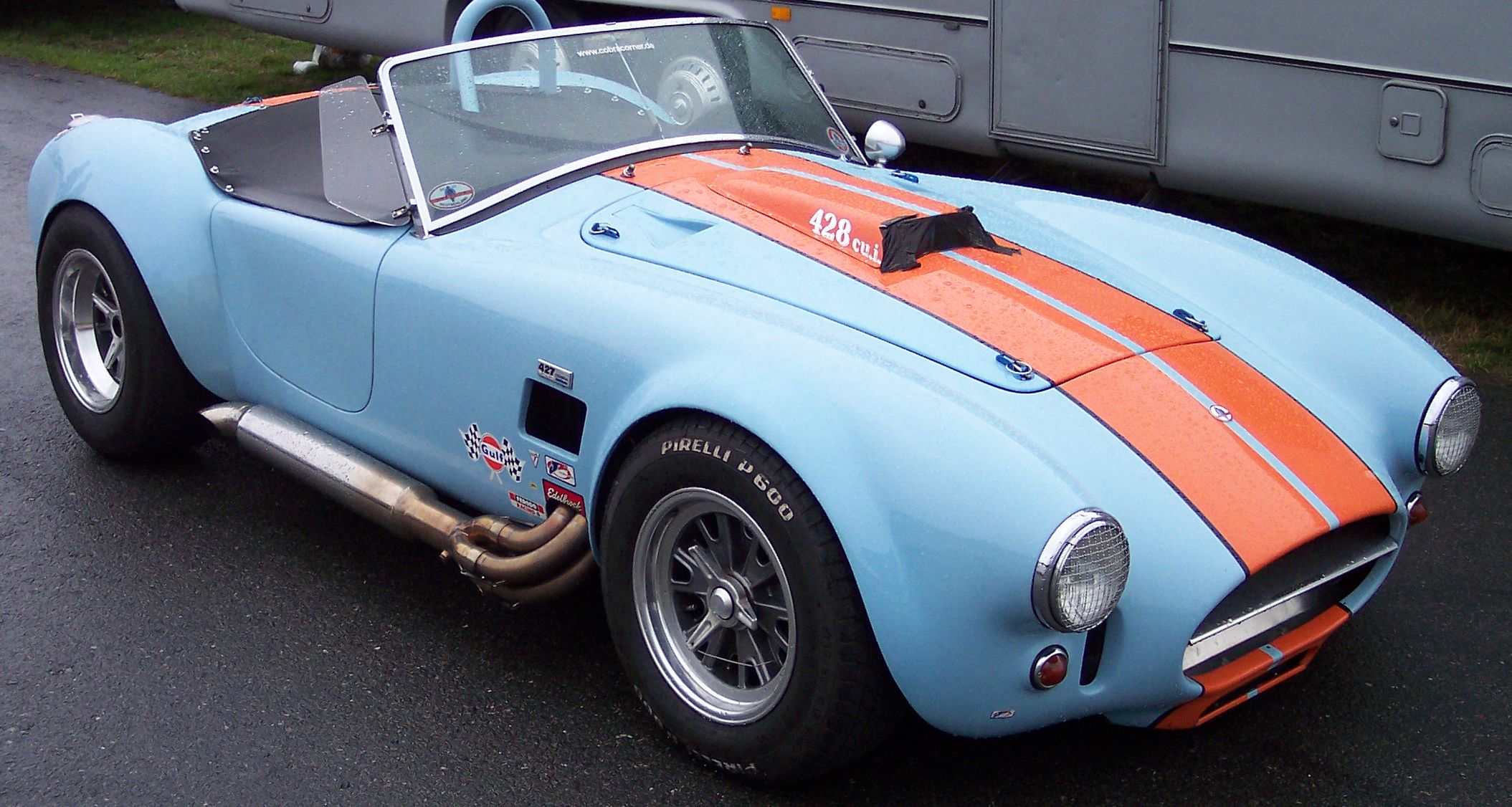
1962 SHELBY 427 COBRA

File:Shelby AC 427 Cobra vl blue.jpg
The AC Cobra, sold as the Ford/Shelby AC Cobra in the United States and often known colloquially as the Shelby Cobra in that country, is an American-engined British sports car produced intermittently since 1962.
Like many British specialist manufacturers, AC Cars had been using the Bristol straight-6 engine in its small-volume production, including its AC Ace two-seater roadster. This had a hand-built body with a steel tube frame, and aluminium body panels that were made using English wheeling machines. The engine was a pre-World War II design of BMW which by the 1960s was considered dated. Bristol decided in 1961 to cease production of its engine and instead to use Chrysler 331 cu in (5.4 L) V8 engines. AC started using the 2.6 litre Ford Zephyr engine in its cars. In September 1961, American automotive designer Carroll Shelby wrote to AC asking if they would build him a car modified to accept a V8 engine. AC agreed, provided a suitable engine could be found. Shelby went to Chevrolet to see if they would provide him with engines, but not wanting to add competition to the Corvette they said no. However,Ford wanted a car that could compete with the Corvette and they happened to have a brand new engine which could be used in this endeavor: Ford's 260 in³ HiPo (4.2 L) engine – a new lightweight, thin-wall cast small-block V8 tuned for high performance. Ford provided Shelby with two engines. In January 1962 mechanics at AC Cars in Thames Ditton, Surrey fitted the prototype chassis CSX2000 with a 260 ci Ford V8 borrowed from Ford in the UK; the 221 ci was never sent. However, early engineering drawings were titled "AC Ace 3.6". After testing and modification, the engine and transmission were removed and the chassis was air-freighted to Shelby in Los Angeles on 2 February 1962. His team fitted it with an engine and transmission in less than eight hours at Dean Moon's shop in Santa Fe Springs, California, and began road-testing.
Production proved to be easy, since AC had already made most of the modifications needed for the small-block V8 when they installed the 2.6 L Ford Zephyr engine, including the extensive rework of the AC Ace's front end bodywork. The most important modification was the fitting of a stronger rear differential to handle the increased engine power. A Salisbury 4HU unit with inboard disk brakes to reduce unsprung weight was chosen instead of the old ENV unit. It was the same unit used on the Jaguar E-Type. On the production version, the inboard brakes were moved outboard to reduce cost. The only modification of the front end of the first Cobra from that of the AC Ace 2.6 was the steering box, which had to be moved outward to clear the wider V8 motor.
The first 75 Cobra Mark I (including the prototype) were fitted with the 260 cu in (4.3 L). The remaining 51 Mark I model were fitted with a larger version of the Windsor Ford engine, the 289 cu in (4.7 L) V8. In late 1962 Alan Turner, AC's chief engineer completed a major design change of the car's front end to accommodate rack and pinion steering while still using transverse leaf spring suspension. The new car entered production in early 1963 and was designated Mark II. The steering rack was borrowed from the MGB while the new steering column came from the VW Beetle. About 528 Mark II Cobras were produced to the summer of 1965 (the last US-bound Mark II was produced in November 1964).
Since late 1962 when the new GM Stingray was shown up briefly by the Mk1 Cobra (until hub failure intervened) the development of the Grand Sport Corvette program had continued at a pace and was thought to be going for a build series of 125 cars. This would allow GM to compete directly in the FIA GT class of racing. Just to compound this Enzo Ferrari was trying to pull another "fast one" on the FIA with the request for the homologation of the 250LM. The FIA had not forgotten the serious lack of production of the 250GTO, which it had granted homologation in advance of Enzo's assured 100 minimum per year. Just thirty-six were produced over three years with two very different chassis, neither of which were too similar to the 250 GT which was supposed to form the basis of the vehicle. In an effort to prepare for the task ahead alternative engines were considered. The 289 cu in (4.7 L) leaf-spring Cobra dominated the US domestic race series (USRRC), with only one race lost in three years. The results in the FIA GT class were different. This was mainly due to the number of circuits that had much higher sustained speeds. Aerodynamics were more important and put the roadster at a disadvantage. As a result, coupe versions were built.
A stroker 289 (325),and the larger 390/427 up to the "cammer" 427 was considered. Shelby was told at the eleventh hour to use the iron 427 cu in (7.0 L). There was little time to fully develop a competition vehicle. The coil spring Cobra production was slow and an insufficient number made to meet FIA's GT homologation. Therefore the S/C (Semi – Competition) was produced by making available to the general production the full race options for the street. By now Enzo was having races recategorised in Italy to prevent the almost inevitable defeat on home soil as the 250LM was not homologated as a GT and would have to run as a prototype. GM had pulled the plug on the Grand Sport and so the five chassis that were built had to run as prototypes and so were placed in a difficult position to say the least.
Shelby had earlier in 1964 fit a larger Ford FE engine of 390 cubic inches (6.4 L) in to CSX2196. Unfortunately the car was not able to receive the development it needed as resources were aimed at taking the crown from Ferrari in the GT class. Ken Miles drove and raced the FE-powered Mark II at Sebring and pronounced the car virtually undriveable, naming it "The Turd". It failed to finish with the engine expiring due to damper failure. A new chassis was required developed and designated Mark III. CSX2196 was revised for the show down at Nassau which allowed a more relaxed class division of racing. This allowed the GT cobras to run with prototype Ford GT, GM Grand Sport Corvettes and Lola Mk.6. The first meeting that the GS Corvettes turned up to in 1963. It was for this event in 1964 that the Fliptop cobra was used. An aluminium 390 cubic inches (6.4 L) engine was used. However, the car failed to finish.
The new car was designed in cooperation with Ford in Detroit. A new chassis was built using 4 in (102 mm) main chassis tubes (up from 3 in (76 mm)) and coil spring suspension all around. The new car also had wide fenders and a larger radiator opening. It was powered by the "side oiler" Ford 427 engine (7.0 L) rated at 425 bhp (317 kW), which provided a top speed of 164 mph (262 km/h) in the standard model and 485 bhp (362 kW) with a top speed of 185 mph (298 km/h) in the competition model. Cobra Mark III production began on 1 January 1965; two prototypes had been sent to the United States in October 1964. Cars were sent to the US as unpainted rolling chassis, and they were finished in Shelby's workshop. Although an impressive automobile, the car was a financial failure and did not sell well. In fact to save cost, most AC Cobra 427s were actually fitted with Ford's 428 cubic inches (7.01 L) engine, a long stroke, smaller bore, lower cost engine, intended for road use rather than racing. It seems that a total of 300 Mark III cars were sent to Shelby in the USA during the years 1965 and 1966, including the competition version. 27 small block narrow fender versions, which were referred to as the AC 289, were sold in Europe. Unfortunately, The MK III missedhomologation for the 1965 racing season and was not raced by the Shelby team. However, it was raced successfully by many privateers and went on to win races all the way into the 1970s. The remaining 31 unsold examples were detuned and fitted with wind screens for street use. Called S/C for semi-competition, an original example can currently sell for 1.5 million USD, making it one of the most valuable Cobra variants.
Shelby wanted the AC Cobras to be "Corvette-Beaters" and at nearly 500 lb (227 kg) less than the Chevrolet Corvette, the lightweight roadster accomplished that goal at Riverside International Raceway on 2 February 1963. Driver Dave MacDonald piloted CSX2026 past a field of Corvettes, Jaguars, Porsches, and Maseratis and recorded the Cobra's historic first-ever victory. Later, Shelby offered a drag package, known as the Dragonsnake, which won several NHRA National events with Bruce Larson or Ed Hedrick at the wheel of CSX2093. Only five Dragonsnake Cobras were produced by the factory, with three others (such as CSX2093) prepared by customers using the drag package.
An AC Cobra Coupe was calculated to have done 186 mph (299 km/h) on the M1 motorway in 1964, driven by Jack Searsand Peter Bolton during shakedown tests prior to that year's Le Mans 24h race. A common misconception is that this incident persuaded the British Government to introduce the 70 mph (110 km/h) maximum speed limit on UK motorways, which up until that year had no speed restrictions, although government officials have cited the increasing accident death rate in the early 1960s as the principal motivation, the exploits of the AC Cars team merely highlighting the issue.
The AC Cobra was a financial failure that led Ford and Carroll Shelby to discontinue importing cars from England in 1967. AC Cars kept producing the coil-spring AC Roadster with narrow fenders, a small block Ford 289 and called the car the AC 289. It was built and sold in Europe until late 1969. AC also produced the AC 428 until 1973. The AC Frua was built on a stretched Cobra 427 MK III coil spring chassis using a very angular steel body designed and built by Pietro Frua. With the demise of the 428 and succeeding 3000ME, AC shut their doors in 1984 and sold the AC name to a Scottish company. The company's tooling, and eventually the right to use the name, were licensed by Autokraft, a Cobra parts reseller and replica car manufacturer owned by Brian A. Angliss.
The Ace chassis numbers read AEX... "A" being the car series and "X" being for export with left-hand drive. Later with the introduction of the Bristol engine the chassis numbers ran "BEX..." When switching to the Ford 2.6 engine the Ace chassis numbers ran "RS..." for Ruddspeed as Ken Rudd may have been influential in the choice of engine. The first Cobra chassis was left hand drive and given the next letter in the alphabet,i.e. C. Then "SX" for "Shelby eXport" ie exported to USA. Therefore the numbers ran CSX... for all the US export Cobras. The four following numbers ran from 2000 sequentially. When the MKIII Cobra was built the identification ran from CSX3000, the 3 signifying coil spring suspension(for left hand drive export). There were other numbers used such as "COB...." for "Cobra Britain" ie RHD home market and and "COX..." for "Cobra Export" ie RHD export other than to USA.